Alpa Ponda
Sem 2
Batch 2016-2018
Paper No. 7
Literary Theory and Criticism
Submitted to :smt. S B Gardi department of English
Enrolment no: 2069108420170025
Introduction
Bharatmuni talked about rasa in this
“natysastra” before the third century. The natyasastra is a compendium of
performed arts:drama,music and dance. “natyasastra is the function of fine arts
in india.” In natysastra he discussed about ‘Rasa theory’ and ‘bhava’, and the connect
of character languages, music employed in drama.
‘Bhava & Rasa’
“Where the hand goes, the gaze follows.
Where the eyes turn. There goes the mind. Where the mind goes, there comes
bhava. And where the bhava comes, there also will be Rasa.”
Rasa is intervowen in acting means
abhinaya. There are four types of abhinaya.
1. Agnik abhinaya
-
Movment of body is important during acting
-
It is called angik
abhinaya.
2. Vachik abhinaya
-
The speaking skill while acting
-
It is called vachik abhinaya.
3. Ahariya abhinaya
-
Ahariya means prop[erty, cloth
-
The action acts theough his movement with property and cloth.
-
It is called ahariya abinaya.
4. Satvik abhinaya
-
Satvik is the best stage of acting.
-
It is thestage during which the character acts form the heart
and bhava rasa are created. There is an aesthetic pleasure to watch satvik
abhnaya.
Types of Rasa
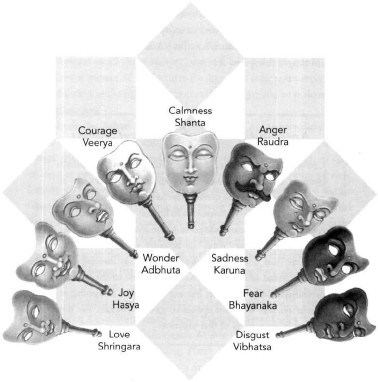
According to bharat’s natyshstra,
there are eight basic feelings or menta states.
There
are delight (riti), laughter(hasya), sorrow(shoka),
anger(krodh),heroisn(utsaha), fear(bhaya), digust(jgupsa) and woder(vismaya).
Elaborating
Rasa:
1) Srungara Rasa
The sringra rasa
proceeds from the dominate state of love. In sringar rasa ‘shubh’ is in center.
The delightment of the characters and situation are the focused. It is also
presented by the love of man and woman. The love comes with the appropriate
season. There is a view of pleasurable
places like park, rivers etc. but modern settings are changed now. It is
reflected with the movment of eyes, eyebrow, soft and modest movment of body,
shringra rasa is connected with ‘apprasail’ the we see in kalidasa’s
literature. Abhigyanshkuntalam is the best example of shringra rasa. As the
writer very heavily and with the mood. Describes the love ife of shakuntala and
dushiyant.
It is also
repreting love of separation. In poems and description shringra rasa is faunal.
2) Hasya Rasa
It is very
difficult to describe or to write comic scene because we should not create
comedy, comedy comes at it own. Bharatmuni says that.
“the humor arises
from the grotesque and custom of others shameless character craze for sensual;
pleasure, mischief foul words. Physical handicapped accusation of others and
the like.”
The hasya is
very important in drama. In one act or there act play, there should hasya
because hasya is the spam of relief. The audience can not be in one mood. So
they requires comedy.
3) Karuna Rasa
Karuna means
pathetic sentiment. It is the dominant state of sorrow. The situation like
sepertion of lovers, death scene, loose of property accident, karuna comes from
the heart.
The character
shows karuna by their lower and deeper emotions, tears on cheeks. E.g. Romeo
and Juliet creates karuna rasa.today’s movie represent the karuna rasa very
well.
4) Rudra Rasa
Rudra means
anger. Anger is represented with the movement of eyes, arms cheeks. It is
terrible to control. So Rudra rasa sometimes terrifies the others.it is the
high state of sometimes and energy burns in this stage fully.e.g. we find some
characters in movies the rigid type characters who rudra rasa during whole the
movie.
5) Vira Rasa
It is the best
rasa which represent the great deed of the hero. it is also an energetic
emotion yellow and orange colour are related with vira rasa.
In drama the vira rasa is represented through firmness
passion, charity, and horizon.
We find there types of
vira.
1) Danvira
2) Dharmvira
3) Yudhvira
6) Bhayanka Rasa
Bhayanka Rasa
has its dominant state of fear. The atmosphere and situation also should be
conducted well during the oart of bhayanka rasa. The voices of animals like
wolves etc. are used to terrify the character. Most of the horror movies use
this type of incident.
It is the high stage of terrified emotion
where in one of afraid of something.
7) Bibhatsya Rasa
This Rasa is
dominant stage of disguise. It is represented by stopping the movement.
Narrowing down of the mouth vomiting.
We feel that it
is happning in reality if it is also discussed just like disguised things.
8) Adbhuta Rasa
It has the
dominant state of amazed and surprised. It is like utopian state of expression.
When nothing is expectable then it comes. This Rasa comes on face. It is the
charm of the scene or incident.
9) Shanta Rasa
This Rasa is the
last. It is the state of mind and heart where in there is the peace. It would
be of happiness or of sadness. It is also connected with enlightenment and
spiritual experience. Today in this materialized World, everyone wants the
place of shanta rasa. They all are in searchof shanta rasa.
Here I attach
the pdf of mono act script named ‘ shant ras nu sarnamu apo’ written by Bharat
yagnik. Wish you real this for energetic experience.
This is a good example of all rasa in one
literary piece. The story of a lover includes all rasa is there and search of
rasa it is the shekspher for our society that all wants shanta its address. The
transformation from one rasa to another rasa is combined very beautifully by
the writer.
Comments
Post a Comment